
The Solar and Battery Rebate, Step by Step
The Solar and Battery Rebate, Step by Step
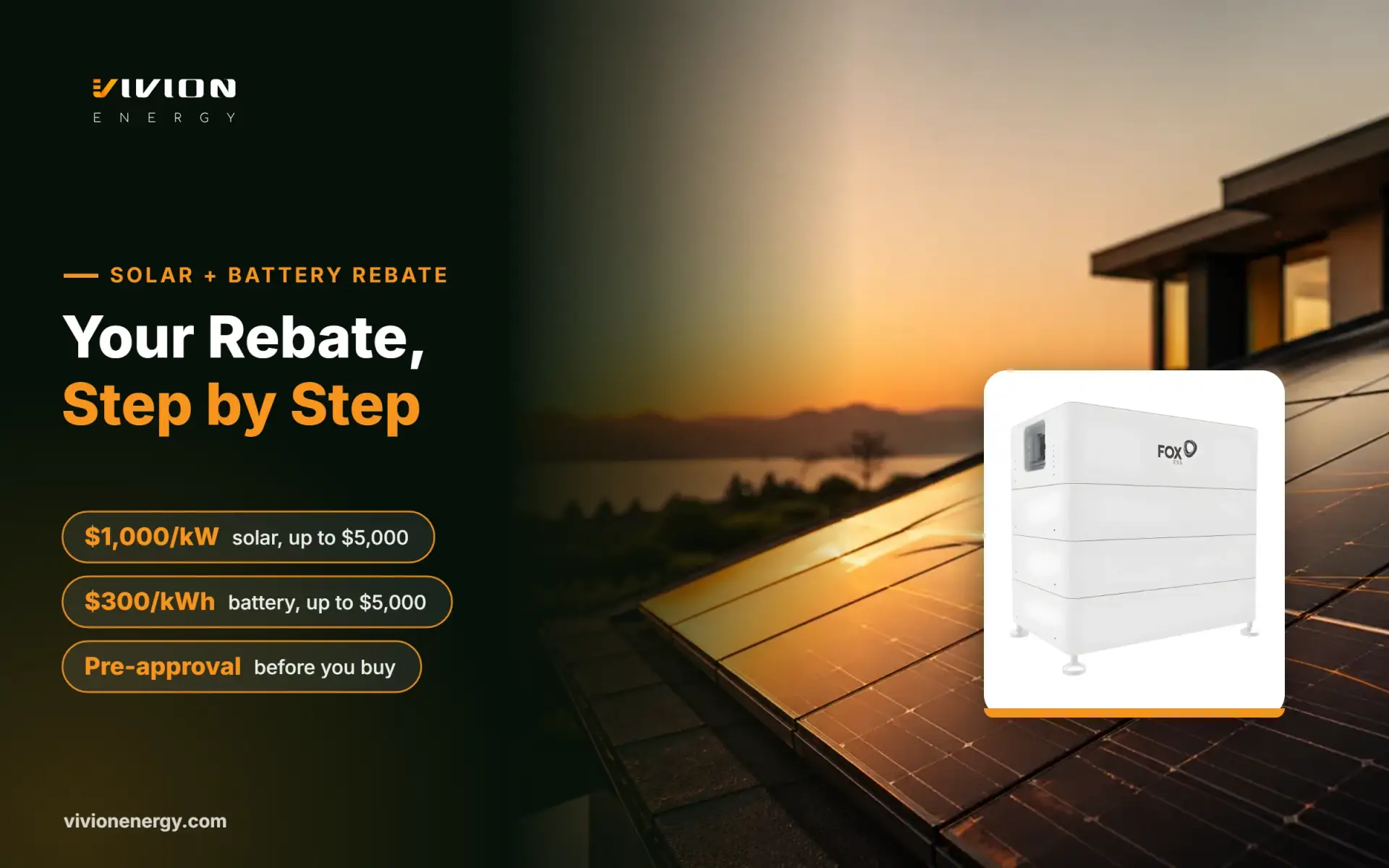
Ontario’s Home Renovation Savings program offers rebates for rooftop solar panels and for a battery installed with them. The money is useful, but the order you do things in matters just as much. Buy equipment too early and you can lose the rebate. Here’s the process from start to finish, in plain language.
The rebate in one glance
As listed on the program’s solar page on November 27, 2026:
- Solar panels: $1,000 per kW, up to 50% of total costs, to a maximum of $5,000.
- Battery storage: $300 per kWh, up to 50% of total costs, to a maximum of $5,000.
Eligibility depends on program rules – we can help check during your consultation. We covered the basic rules in our solar and battery rebate FAQ, so this post focuses on the steps.
Step 1: Check that your home fits
The program lists these basics:
- You are at least 18 and own the home. If you have tenants, the owner applies.
- The home is a single detached, semi-detached, row house, townhome, or mobile home on a permanent foundation.
- You pay for the purchase and installation.
- The home is connected to the Ontario electricity grid. Cornwall Electric customers are not eligible.
The first step is a short eligibility form on the program website.
Step 2: Decide between the rebate and net metering
This is the choice people most often miss. The program’s incentive is for “load displacement,” meaning your solar power is used to meet your own home’s needs. If you take the rebate, you cannot also sign a net-metering agreement with your local utility. Net metering is the arrangement where extra power goes to the grid for bill credits, which the Ontario Energy Board says carry forward for up to 12 months. You choose one or the other, so weigh both with your installer.
Step 3: Your contractor applies, and your utility weighs in
Once you pick a contractor, they submit the pre-installation form. The program’s help page says applicants are contacted within a week of that submission. Your contractor also helps you get connection approval from your local utility. The help page calls this a Connection Assessment with your local distribution company, along with any permits that apply.

Step 4: Wait for written pre-approval
Do not buy or install anything until you have written pre-approval from the Home Renovation Savings team and your local utility. The program is firm on this. It is the easiest way to protect your rebate.
Step 5: Installation and paperwork
After pre-approval, your contractor installs the system to program requirements and submits the final documents. The rebate is paid once the application is approved.
What size system does the program expect?
The help page says the solar array should ideally match the home’s typical energy use. It also says typical systems range from 5 to 10 kW, and larger systems may need more information. A battery must be paired with a new solar system, sized for that system and designed mainly to store solar power rather than grid power.
Example (an estimate only): on a 7 kW solar system, $1,000 × 7 = $7,000. That is above the $5,000 maximum, so the solar rebate would be capped at $5,000, as long as $5,000 is no more than 50% of total costs. Your actual amount depends on your system, its cost and program rules. This is not a sizing recommendation for your home.
What to have ready
A little preparation keeps things moving once you start:
- Recent electricity bills, so your installer can see how much power your home uses through the year.
- Your utility account details, since your local distribution company is part of the approval.
- Any notes on your roof’s age or condition. Our before-you-install FAQ explains why roof condition matters.
Three rules that catch people out
- Existing systems don’t qualify. Expansions of existing solar, including microFIT projects, are not eligible.
- Funding has a ceiling. The help page says combined funding from other sources must not exceed 100% of the project’s cost.
- Watch for scams. The program warns about fake websites and people pretending to be approved contractors. Its scam page explains what to look out for.
Curious what solar and a battery could look like for your home? Book a free consultation with Vivion Energy and we’ll go through the steps with you.
Sources
Information is current as of November 28, 2026. Programs and rates can change, so check the official source or contact us before making decisions.