
How a Home Battery Works in an Ontario Home
How a Home Battery Works in an Ontario Home
A home battery can sound like a mystery box on the garage wall. In reality it does a few simple jobs: it stores electricity, hands it back when you need it, and can keep selected circuits running when the grid goes down. Here is how those pieces fit together in an Ontario home.
The basic idea: store now, use later
A battery stores electricity in modules, much like a very large version of the battery in your phone. It can be charged from the grid and, if you have solar panels, from your own solar power. Later, your home draws from the battery instead of the grid.
Most home batteries work with a hybrid inverter. Your battery stores direct current (DC) power, while your home runs on alternating current (AC). A hybrid inverter is the device that converts between the two and manages the flow between solar, battery, home and grid.
Charging and using power around your hydro price plan
Ontario homeowners can choose between Time-of-Use (TOU), Ultra-Low Overnight (ULO) and tiered pricing, according to the Ontario Energy Board (OEB). TOU and ULO prices change by time of day. ULO includes a very low overnight period, while evening hours are the most expensive.
That price gap is where a battery can help. A system can be set to charge when electricity is cheaper and supply your home when it costs more. The OEB resets electricity prices every November 1, so check its site for the current numbers before comparing plans. Whether this makes sense for you depends on your home, your usage and your plan.
If you have solar, the battery can also store extra daytime power for use in the evening, rather than sending it all back to the grid.
What happens during a power outage
This is the part many homeowners ask about. When the grid goes down, a battery system with backup capability disconnects from the grid and keeps selected circuits running. Fox ESS says its HUB G2 unit has a transition time of 20 ms between on-grid and off-grid operation and includes three smart circuits for load control, according to the Fox ESS PowerQ series page.
Which circuits are backed up, and for how long, depends on the battery size, what you plug into those circuits and how much charge is left. A battery is not a promise to run an entire home for a set number of hours, so it helps to decide ahead of time what matters most, such as the fridge, lights, internet and a few outlets.
Numbers worth knowing, from the manufacturer
According to Fox ESS, its PowerQ series has a modular design that scales up to 80 kWh, a depth of discharge of 90% and charge and discharge efficiency above 95%. In plain words, depth of discharge is how much of the stored energy the battery is designed to use, and efficiency is how much energy you get back out compared with what went in. These are manufacturer figures, and real-world results depend on your system and how you use it.
Fox ESS also says the system can be monitored remotely through a smartphone app or web portal, so you can see when the battery is charging, discharging or holding power.
Tips for living with a battery
- Know your backup settings. Many systems let you keep a reserve of stored energy for outages. Ask your installer how the reserve setting works on your system.
- Check the app now and then. A quick look shows whether the system is behaving as expected before storm season or a cold snap.
- Match the plan to your habits. If most of your usage is in the evening, a price plan with cheaper overnight power may be worth comparing.
- Leave electrical work to licensed professionals. Batteries and inverters should only be installed, opened or repaired by a licensed electrical contractor.
What Vivion offers
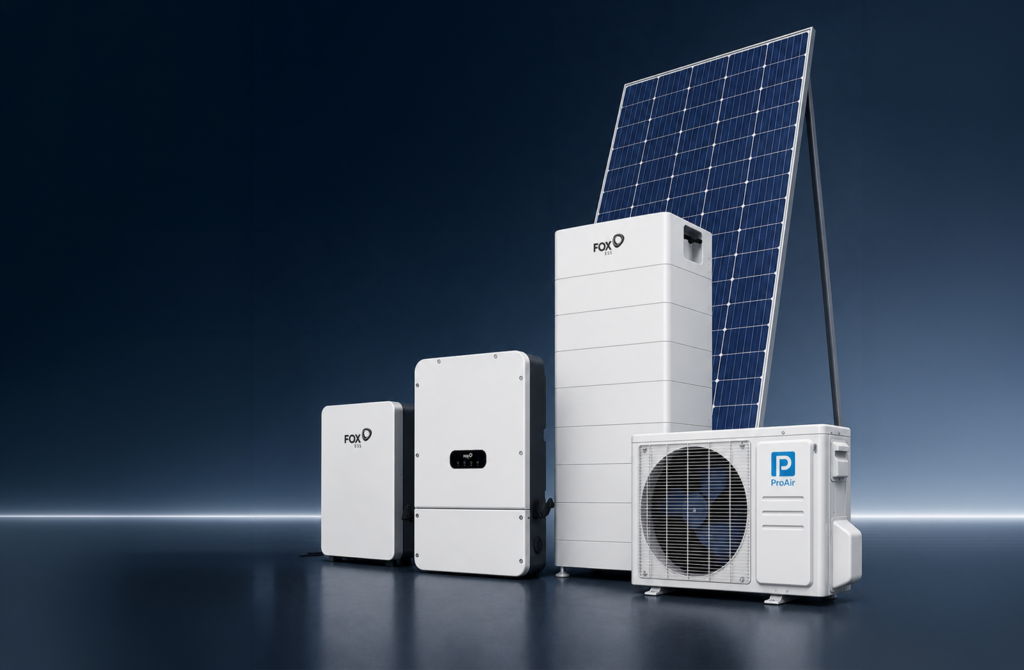
Vivion Energy is an authorized Fox ESS dealer and installs the Fox ESS US-Series (Flex) and AIO PowerQ home battery systems. Battery sizes range from 8 to 56 kWh in 4 kWh steps, with 9.6 or 11.4 inverter options, and packages include the inverter, battery modules and a battery stand. The right size is confirmed during a consultation, not guessed from a blog post. You can also try the Saving Calculator for a rough estimate, which depends on your home and program rules.
If you would like to talk through whether a battery fits your home, book a free consultation with Vivion Energy.
Sources
Information is current as of October 12, 2026. Programs and rates can change, so check the official source or contact us before making decisions.